
Last Updated on July 27, 2026 by Tim L. | Founder of Pest Control Playbook
The Most Common Reasons Professional Ant Bait Fails – And How to Fix Every One of Them
You set out the bait. You waited. The ants are still marching across your kitchen counter like you did nothing at all. If you’re watching ant bait sit completely untouched — or worse, watching ant numbers climb after treatment — you’re not alone. This is one of the most common complaints I hear from homeowners in the field, and after 30 years in the pest control industry, I can tell you the answer is almost never “the bait is bad.”
Ant bait failure is almost always caused by something the applicator did, didn’t do, or didn’t know. The good news: every single cause of ant bait failure is correctable. This guide walks through each one in detail so you can stop wasting product and start getting real results.
First — Understand How Ant Bait Is Supposed to Work
Ant bait operates on a beautifully simple principle that makes it one of the most powerful tools in pest management — when used correctly.
Foraging ant workers are the ants you see. Their entire job is to travel away from the colony, locate food sources, and carry food back to share with the rest of the colony — queens, larvae, and non-foraging workers — through a process called trophallaxis, or direct food sharing. Gel bait exploits this behavior:
- A foraging worker finds the ant bait and feeds on it
- She carries it back to the nest
- She shares it with nestmates, larvae, and queens through trophallaxis and fecal deposits
- The toxicant spreads through the colony and causes a cascading kill — reaching individuals that never came near the bait
This is why ant bait, done right, eliminates entire colonies rather than just the foragers you can see. It is far superior to sprays for long-term control. In my experience, and baiting requires patience, correct product selection, and proper technique. When any of those elements are off, bait fails.
💡👉💡 PRO TIP– Read this article Best Ant Baits 2026 First
Reason #1: You Used a Repellent Spray Before or During Baiting
This is the single most common cause of ant bait failure, and in three decades of professional pest management, I’ve seen it sabotage more treatment programs than any other mistake.
When you apply a pyrethroid-based spray — any standard over-the-counter ant killer like Raid, Hot Shot, Ortho Home Defense, or similar products — ants detect the repellent chemistry and avoid the treated area entirely. This sounds like a good thing. It isn’t.
Here’s what actually happens:
- The spray kills the foragers it directly contacts
- The surviving ants detect the chemical threat and reroute — moving through different pathways, potentially deeper into walls and structural voids
- Any bait placed near the sprayed area is now in a chemically contaminated zone that ants will not enter
- The colony is not eliminated — it is disrupted and potentially caused to bud, meaning queens and workers split off and establish new satellite colonies elsewhere in your home
Pyrethroids persist on surfaces for weeks to months. If you sprayed your baseboards two weeks ago and are wondering why your freshly placed bait isn’t working, contamination is almost certainly the answer.
What to Do
Stop all repellent spray applications immediately. In heavily sprayed areas, clean surfaces with soap and water and allow them to dry before placing fresh bait. Commit fully to a bait-only approach and do not mix spray and bait programs. This is non-negotiable for effective ant control.
Reason #2: You Used the Wrong Type of Bait for Your Ant Species
After 30 years in this industry, this is the mistake I see most often from well-meaning DIYers: grabbing whatever ant bait is on the shelf without knowing what species they’re dealing with or what that species actually wants to eat.
Ants are not all the same. Their dietary preferences vary significantly by species, by season, and even by colony reproductive cycle. Using the wrong bait matrix means ants have zero interest in what you’ve put out.
Sweet Feeders vs. Protein Feeders vs. Grease Feeders
Most ant species cycle between nutritional needs depending on the time of year and what the colony requires:
- Sweet/carbohydrate baits attract ants when the colony needs energy — often during active foraging seasons when workers need fuel
- Protein baits attract ants when the colony needs to feed developing larvae and support reproduction — often in spring and early summer
- Grease/lipid baits are preferred by certain species like grease ants and some phases of odorous house ant colonies
If you put out a sweet bait and your colony is in a protein-feeding phase, ants will ignore it completely. This doesn’t mean baiting doesn’t work — it means you have the wrong bait matrix for the moment.
💡👉💡 Why do I even have Ants in the House to Begin With? Read THIS Article
Species-Specific Preferences
- Odorous house ants — primarily sweet feeders but will shift to proteins; highly attracted to liquid and gel sugar baits
- Pavement ants — omnivorous, respond well to both sweet and protein baits
- Carpenter ants — primarily protein and liquid feeders; standard gel baits often underperform; liquid baits and protein gels work better
- Pharaoh ants — protein feeders, especially when reproducing; require specifically formulated Pharaoh ant baits
- Argentine ants — strong preference for sweets; liquid sugar baits often outperform gel for this species
- Fire ants — outdoor mound treatments require granular bait products; indoor gel baits are largely ineffective
What to Do
I always try to identify the species of ants first, then match the bait to the species and the season. If you’re uncertain which type to use, put out both a sweet bait and a protein bait in separate locations and observe which one gets feeding activity. Let the ants tell you what they want.
Reason #3: The Bait Placement Is Wrong
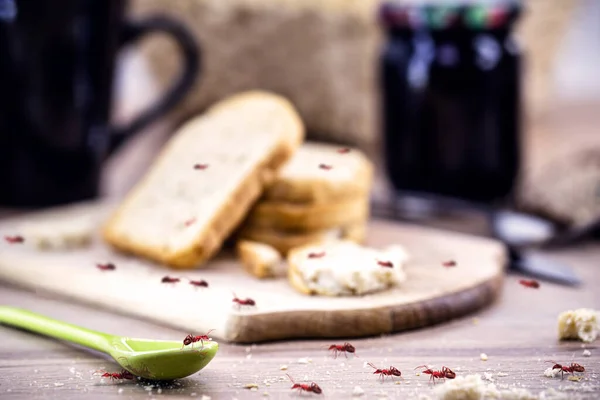
You can have the perfect bait for your species and still get zero results if the bait is in the wrong location. In 30 years of ant treatments, placement errors are responsible for a huge percentage of bait failures.
Ants Don’t Forage Randomly
Ant foragers follow pheromone trails — invisible chemical highways laid down by scouts that communicate the location of food sources back to the colony. These trails run along edges: baseboards, countertop edges, pipe runs, window sills, the junction between floor and wall. Ants rarely venture into open spaces.
Placing bait in the middle of an open floor, on an exposed countertop surface, or anywhere away from established travel routes means foragers may never encounter it.
Where Bait Should Go
- Directly on or immediately adjacent to active ant trails — this is the highest-priority placement
- Along edges and junctions — baseboards, cabinet edges, under sink frames, along pipe penetrations
- Near entry points — where ants are coming in: gaps around pipes, window frames, door thresholds
- Near moisture sources — under sinks, near dishwashers, around any area with pipe condensation or slow drips
- In harborage areas — inside cabinet hinges, under appliance edges, in undisturbed corners
Common Placement Mistakes
- Bait placed too far from active trails
- Large globs in a few spots instead of small placements in many locations
- Bait placed only where ants are most visible rather than where they travel
- Bait placed on clean, open surfaces instead of in tight, sheltered locations
The Right Amount
Pea-sized placements — roughly 0.5 grams — work better than large deposits. Small, frequent placements across many locations dramatically outperform fewer large ones.
👉💡👉 Ants in Your Apartment? How to Get Rid of Them For Good
Reason #4: The Colony Is Budding
This is the ant behavior that, in my experience, causes more confusion and frustration than almost anything else in residential pest control. And it almost always happens as a direct result of using repellent products — which brings us back to Reason #1.
Budding is a survival mechanism used by certain multi-queen ant species. When a colony detects a serious threat — a chemical repellent, a physical disturbance, a heavy-handed treatment — one or more queens, along with a group of workers and brood, simply detach from the main colony and relocate. What was one colony becomes two, three, or more — each establishing themselves in a new location, often deeper inside the structure.
The ant species most notorious for budding include:
- Pharaoh ants — the champions of budding; a single misapplied spray treatment can fracture one colony into dozens
- Argentine ants — supercolonies that fragment readily under pressure
- Odorous house ants — multi-queen colonies that bud readily when disturbed
Signs Your Colony Is Budding
- Ant activity suddenly appears in new locations after a spray treatment
- You’re seeing ants in rooms or areas where you never had them before
- Populations seem to be spreading rather than declining after treatment
What to Do
Stop all repellent treatments immediately. Switch exclusively to non-repellent bait. Give the fragmented colonies time to stabilize and begin foraging again — then let the bait do its work. Patience is essential here. A budded infestation takes longer to resolve but will respond to correct baiting if you stay the course.
Reason #5: You’re Not Giving the Bait Enough Time
This is a hard one for most people to accept, because an active ant infestation is stressful and the urge to do something — anything — is powerful. But ant bait requires time, and interfering with the process resets the clock.
Here’s the reality of how long proper ant baiting takes:
- Initial feeding activity typically begins within hours to a few days of correct placement
- Noticeable population reduction usually takes 1 to 2 weeks
- Full colony elimination for large or well-established colonies can take 4 to 6 weeks or longer
During this time, you may actually see more ant activity around the bait before you see less. This is a good sign — it means foragers have found the bait and are actively recruiting nestmates to the food source. Many people interpret this activity spike as the bait not working and intervene with a spray, destroying weeks of progress in a single moment.
What to Do
Place the bait correctly, verify feeding activity is occurring, and then leave it alone. Replenish bait stations as they are consumed. Do not spray. Do not disturb the trails. Let the bait work.
Reason #6: The Bait Has Dried Out or Gone Bad
Gel bait has a limited effective lifespan once applied. Exposed to air, heat, and environmental conditions, bait dries out, hardens, and loses both its palatability and its moisture content — which is often part of what attracts ants in the first place.
Dried, hardened bait is not just ineffective — it can actually deter feeding because it no longer presents as a viable food source to foraging workers.
What to Do
Check bait placements regularly. Replace any bait that has dried, hardened, changed color significantly, or shows signs of contamination (dust, debris, dead insects). In hot, dry environments, bait may need replacing every 1 to 2 weeks. In cooler, more humid conditions it may last longer. Fresh bait always outperforms old bait.
Reason #7: You’re Dealing With Pharaoh Ants and Don’t Know It
I’m giving Pharaoh ants their own section because after 30 years in pest control, they remain one of the most mismanaged pests in residential and commercial settings — and the consequences of misidentification and incorrect treatment are severe.
Pharaoh ants (Monomorium pharaonis) are tiny — 1/16 inch, pale yellow to light brown — and they are masters of survival. They form massive supercolonies with hundreds of queens distributed throughout the nest network. They bud aggressively at the first sign of chemical threat. And they have very specific bait preferences that differ from most other common ant species.
If you are dealing with Pharaoh ants and you spray them, use a repellent product, or use the wrong bait, you will make the infestation dramatically worse. I have seen Pharaoh ant infestations in apartment buildings that were completely out of control specifically because a well-meaning tenant grabbed a can of spray and set off a chain reaction of budding that spread ants to every unit on two floors.
Pharaoh Ant Baiting Requirements
- Bait only — no repellent products anywhere in the building
- Protein-based bait — Pharaoh ants are primarily protein feeders, especially when actively reproducing
- Building-wide program — Pharaoh ant control in multi-unit buildings requires treating every unit, not just the ones with visible activity
- Extended timeframe — eliminating a mature Pharaoh ant infestation can take several months of consistent baiting
If you suspect Pharaoh ants, call a licensed pest management professional. This is not a DIY situation.
👉💡👉 Get Rid of Ants Now! A Step by Step Guide, Field Tested
Ant Bait Troubleshooting Checklist
Before you give up on baiting, run through this checklist:
- Have you used any repellent sprays in the last 60 days? If yes — contamination is likely your primary issue
- Have you correctly identified your ant species? If no — you may have the wrong bait type
- Is your bait placed directly on or adjacent to active trails? If no — relocate placements
- Are you using a sweet bait or a protein bait? Have you tried both?
- Is your bait fresh? Replace any dried or hardened product
- Have you waited at least 2 to 4 weeks without intervening? If no — give it more time
- Are ants appearing in new locations after treatment? If yes — budding may be occurring from prior spray use

Final Thoughts
Ant bait works. After 30 years treating ant infestations in homes, apartments, restaurants, hospitals, and commercial facilities, I have watched correctly applied bait eliminate colonies that seemed impossible to control. But bait is not a spray — it requires the right product, the right placement, the right technique, and above all, the patience to let it work without interference.
The most successful ant control programs I’ve run share one thing in common: a complete commitment to the bait-only approach, correct species identification, and the discipline to leave the bait alone and let the colony do the work for you.
If you’ve checked every item on this list and are still struggling, it’s time to call a licensed pest management professional who can accurately identify your species and build a treatment program around what you’re actually dealing with.