
Last Updated on July 27, 2026 by Tim L. | Founder of Pest Control Playbook
Where do Roaches Hide? This Guide Explains Where to Look and How to Eradicate Roaches
If you’ve been seeing cockroaches in your home, you’ve probably wondered the same thing: Where is the nest?
The good news is that cockroaches leave clues. The bad news is that they are experts at hiding, and unlike ants or bees, they usually don’t have one large central nest.
After more than 30 years in the pest control industry, I’ve learned that successful cockroach control starts with finding their harborage areas—the places where they spend most of their time hiding, feeding, and reproducing.
In this guide, I’ll show you exactly where to look, the signs you’ve found a cockroach hiding place, and what to do once you locate it.
👉👉💡💡 Quick Answer: Cockroaches don’t usually have a single nest like ants or bees. Instead, they gather in hidden harborage areas near food, water, and warmth. The best places to look include behind refrigerators, under sinks, behind stoves, inside cabinets, around dishwashers, and inside wall voids. Signs you’ve found a cockroach harborage include droppings, egg cases, shed skins, a musty odor, and live cockroaches of different sizes. Inspecting your home at night with a flashlight is often the fastest way to locate where they’re hiding.
Do Cockroaches Have a Nest?
Not exactly.
One of the biggest misconceptions homeowners have is that cockroaches build a single nest like ants or wasps.
Instead, cockroaches create harborage areas. These are protected hiding places close to food, moisture, and warmth. A severe infestation may have several harborages throughout the home.
German cockroaches, the most common indoor species, often stay within just a few feet of their food source. American cockroaches usually spread farther through basements, crawl spaces, utility rooms, and sewer connections.
Finding these harborages is one of the most important steps toward eliminating an infestation.
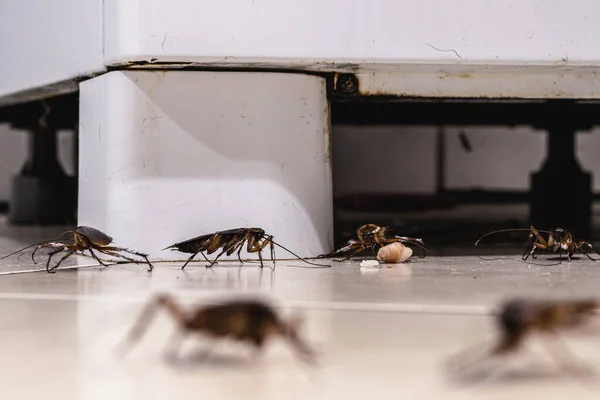
Signs You’ve Found a Cockroach Nest
Cockroaches leave behind several telltale signs.
1. Cockroach Droppings
Small infestations often leave behind tiny black specks that resemble black pepper or coffee grounds.
Larger cockroaches leave droppings that look more like small, dark pellets.
The more droppings you find, the closer you are to their hiding place.
2. Egg Cases (Oothecae)
Female cockroaches produce egg capsules called oothecae.
Depending on the species, these may be attached to hidden surfaces or dropped near protected locations.
Finding multiple egg cases usually indicates an active breeding site.
👉💡 Seeing Roaches During the Day? Read THIS
3. Shed Skins
Young cockroaches shed their outer skin several times as they mature.
Finding numerous shed skins in one location is a strong indication that cockroaches are living nearby.
4. Musty Odor
Heavy infestations often produce a strong, oily, musty smell.
Professional technicians can often identify large infestations by odor alone.
5. Live Cockroaches of Different Sizes
If you’re seeing both tiny baby cockroaches (nymphs) and adults together, you’ve likely found one of their primary harborages.
The Most Common Places Cockroaches Hide
When inspecting your home, focus on warm, dark, protected areas.
Behind the Refrigerator
This is one of the most common hiding places.
The compressor generates warmth while dust and food particles collect underneath.
Pull the refrigerator away from the wall and inspect carefully with a flashlight.
Under the Kitchen Sink
Leaks, moisture, plumbing penetrations, and darkness make this one of the first places professionals inspect.
Look around water lines and cabinet corners.
Behind the Stove
Grease buildup, crumbs, and heat create ideal conditions.
Inspect behind and underneath the appliance whenever possible.
Inside Kitchen Cabinets
Pay close attention to:
- Upper cabinet corners
- Hinges
- Under shelving
- Around plumbing openings
Cockroaches often squeeze into spaces less than 1/8 inch wide.
Dishwasher
Dishwashers produce warmth and moisture while offering numerous hidden voids underneath and behind the unit.
This is especially common with German cockroaches.
Microwave and Small Appliances
Toasters, coffee makers, microwaves, and air fryers sometimes become hiding places if crumbs accumulate over time.
Utility Rooms
Water heaters, washers, dryers, HVAC equipment, and utility sinks all provide warmth and moisture.
These areas are often overlooked by homeowners.
Basements and Crawl Spaces
American cockroaches frequently hide in damp basements, crawl spaces, floor drains, and around foundation walls.
Wall Voids
Cockroaches commonly travel inside walls through:
- Plumbing openings
- Electrical penetrations
- HVAC chases
- Shared apartment walls
If you’re finding droppings around outlet covers, they may be living inside the wall.
Inspect at Night
Cockroaches are primarily nocturnal.
If you inspect during the day, you may never actually see them.
About one hour after dark:
- Turn off the lights.
- Wait quietly.
- Use a flashlight.
- Check kitchens and bathrooms.
You’ll often catch cockroaches moving between their hiding places and food sources.
How Pest Control Professionals Find Cockroach Harborages
Professional inspections follow a systematic process.
Rather than randomly spraying chemicals, experienced technicians look for patterns.
We inspect:
- Moisture sources
- Food sources
- Heat-producing appliances
- Plumbing penetrations
- Grease buildup
- Fecal spotting
- Egg cases
- Shed skins
- Hidden cracks and crevices
These clues often lead directly to the primary harborage.
What to Do After You Find the Nest
Finding the cockroach hiding place is only half the battle.
Step 1: Vacuum Thoroughly
Vacuum droppings, egg cases, shed skins, and as many live cockroaches as possible.
This immediately reduces the population.
Step 2: Apply Gel Bait
Professional gel baits remain one of the most effective treatments for German cockroaches.
Apply small placements inside cracks, corners, and hidden areas—not large globs.
👉💡 Want to Know How to Use Roach Gel Bait Correctly? Read THIS Now
Step 3: Use an Insect Growth Regulator (IGR)
IGRs prevent immature cockroaches from developing into breeding adults.
Combining bait with an IGR is one of the most effective long-term control strategies.
Step 4: Seal Entry Points
Seal gaps around:
- Pipes
- Baseboards
- Cabinets
- Utility penetrations
- Wall openings
Reducing hiding places makes future infestations less likely.
Step 5: Monitor Activity
Place sticky monitoring traps behind appliances and inside cabinets.
These traps help determine whether the infestation is shrinking or whether additional treatment is needed.
Common Mistakes Homeowners Make
Spraying Everything They Can Find
Over-the-counter sprays often scatter cockroaches deeper into walls and make gel baits less attractive.
Ignoring Moisture Problems
Leaking pipes and standing water allow cockroach populations to recover quickly.
Fix water issues whenever possible.
Looking Only in the Kitchen
Bathrooms, laundry rooms, basements, garages, and utility rooms are all common hiding locations.
Expecting One Treatment to Solve Everything
Most infestations require several weeks of monitoring and follow-up treatment.
Patience produces better long-term results.
Frequently Asked Questions
Can cockroaches have more than one nest?
Yes. Most infestations contain several harborages located near food and water sources.
What room usually has the worst infestation?
The kitchen is the most common, especially around refrigerators, stoves, sinks, and dishwashers.
How do I know if the nest is gone?
You’ll notice fewer live cockroaches, fewer droppings, and little or no activity on sticky monitoring traps over several weeks.
Should I spray the nest after I find it?
Not usually. Professional gel baits combined with an insect growth regulator generally provide better long-term results than broadcast spraying.
Can I eliminate a cockroach infestation myself?
Small infestations often can be eliminated with the right products and proper sanitation. Large or widespread infestations may require professional treatment.

Final Thoughts
Finding a cockroach nest isn’t about locating one giant colony—it’s about identifying the hidden harborages where cockroaches spend their time.
By looking for droppings, egg cases, shed skins, moisture, and warm hiding places, you can pinpoint where the infestation is strongest and treat it more effectively.
In my experience, homeowners who take the time to inspect carefully before applying products almost always achieve better results than those who simply spray chemicals and hope for the best.
If you’re dealing with an active infestation, finding the hiding place is the first step toward getting your home back under control.
About The Author
As the founder of Pest Control Playbook, I have more than 30 years of hands-on experience in the pest control industry. Drawing from real-world field work in residential and commercial settings, the goal of this site is to provide homeowners with practical, straightforward pest control advice that actually works.